
For patients living with multiple sclerosis, the news that a new clinical trial has opened for stem cell treatment is both exciting and potentially confusing. How do you find out if you qualify? What does participation actually involve? And how does this development fit into the broader landscape of what is currently available for MS patients? This article answers those questions clearly.
Why Stem Cell Therapy Is Being Studied for MS
Multiple sclerosis is an autoimmune condition in which the immune system attacks myelin — the protective coating around nerve fibres — causing progressive neurological damage. Existing disease-modifying therapies can slow progression in relapsing-remitting MS but are less effective in progressive forms of the disease, and none can repair already damaged myelin.
Stem cell therapy, specifically haematopoietic stem cell transplantation (HSCT), approaches the disease differently: it uses high-dose chemotherapy to suppress the aberrant immune system, then rebuilds it using the patient’s own stem cells — essentially resetting the immune system’s attack on myelin. For patients with aggressive relapsing-remitting MS who have failed conventional therapy, HSCT has shown remission rates that exceed what any current disease-modifying drug achieves in comparable patients.
What Patients Need to Know About Joining an MS Stem Cell Trial
Clinical trials for MS stem cell therapy are not suitable for all patients — eligibility criteria are carefully defined and exist for patient safety reasons. Most HSCT trials for MS are designed for patients with:
- Relapsing-remitting MS (RRMS) — not primary or secondary progressive MS in most current trials
- Evidence of active disease — meaning continued relapses or MRI-confirmed new lesions despite being on a disease-modifying therapy
- Age typically between 18 and 55 (varies by trial)
- Absence of certain comorbidities that would make the chemotherapy conditioning phase too risky
These criteria exist because HSCT is an intensive procedure with real risks, including infection, prolonged immune suppression and, rarely, treatment-related mortality. The patient population must be those whose disease burden justifies the procedure’s risk profile.
How to Find Open Trials on ClinicalTrials.gov
The US National Institutes of Health maintains a comprehensive database of all registered clinical trials at clinicaltrials.gov. To find MS stem cell trials currently enrolling:
- Go to clinicaltrials.gov and use the search bar
- Search: “multiple sclerosis stem cell” with status filter set to “Recruiting”
- Filter by your country and, if relevant, by distance from your location
- Review each trial’s eligibility criteria and contact the trial coordinator listed for each study
You can also search specifically for HSCT (haematopoietic stem cell transplantation) MS trials, which are distinct from mesenchymal stem cell (MSC) trials. Both approaches are being studied, but they work through different mechanisms and have different eligibility profiles.
What Trial Participation Involves
If you qualify for a trial and choose to enrol, you will typically go through a detailed screening process including blood tests, MRI scans and a neurological assessment. The treatment itself — if you are in the active arm of the trial rather than the control arm — involves several stages: stem cell mobilisation and collection, high-dose chemotherapy, and stem cell infusion, followed by a monitoring period that may require several weeks near the trial centre.
Trial participation is typically provided at no cost to the patient for the experimental treatment itself, though associated travel, accommodation and living costs are generally not covered.
Questions to Ask Your Neurologist
If you are interested in exploring a stem cell trial for your MS, start the conversation with your neurologist: Am I a candidate for HSCT based on my current disease profile? Is my MS active enough, and have I failed the right number of prior therapies? Do you know of any trials currently recruiting that would be appropriate for my case? What do you see as my risk profile for the conditioning chemotherapy involved?
Your neurologist’s assessment of your specific disease course is the most important input into this decision.
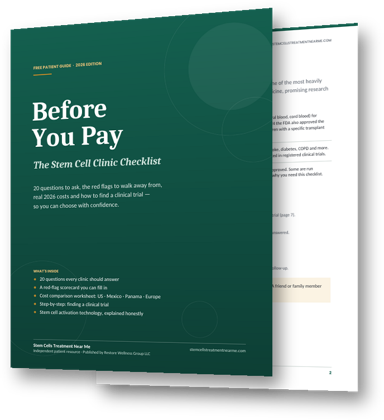
Before You Pay: The Stem Cell Clinic Checklist
- 20 questions every legitimate clinic should answer in writing
- A red-flag scorecard to spot unregulated marketing
- Realistic 2026 cost ranges: US, Mexico, Panama & Europe
- How to find a registered clinical trial
Medical Disclaimer: This article is for informational purposes only and does not constitute medical advice. Always consult a qualified medical professional before pursuing any treatment. See our full Medical Disclaimer.
Exploring your stem cell options? Use our free Clinic Finder to learn how to find and vet a legitimate stem cell clinic near you.