
Medical tourism for stem cell therapy is growing rapidly — and for good reason. Legitimate international clinics can offer comparable treatment at significantly lower cost, with shorter wait times and sometimes access to protocols not yet available domestically. But the same regulatory gaps that allow reputable international clinics to operate also attract providers who prioritise profit over patient safety. This article is a patient safety guide to help you tell the difference before you travel.
Why Regulatory Differences Matter
In the United States, the FDA regulates stem cell therapies as biological drugs, requiring clinical trial evidence before most treatments can be commercially offered. This means that treatments freely available in some international clinics are either not legally offered in the US, or are offered only under strict research protocols.
Different countries regulate this space differently:
- Germany: The Paul-Ehrlich-Institut applies rigorous standards comparable to the FDA. Legitimate German clinics operate within a strict regulatory framework.
- Mexico: Offers a more permissive regulatory environment for stem cell clinics. Many excellent, physician-led clinics operate ethically within this framework. But the same permissiveness that allows legitimate innovation also permits problematic providers to operate with minimal oversight.
- Panama: A relatively well-regulated environment for medical tourism, with growing government oversight of regenerative medicine clinics. Quality varies significantly between providers.
- Some other countries: A small number of destinations actively market to international stem cell patients with essentially no meaningful regulatory oversight. Patient safety in these environments is the patient’s responsibility entirely.
Red Flags: When to Walk Away
These warning signs should cause you to pause — and in most cases, walk away from a clinic entirely:
1. Claims of Treatment for Any Condition
Legitimate stem cell clinics specialise. If a clinic’s website or sales materials claim their therapy treats cancer, Parkinson’s, MS, autism, COPD, diabetes, HIV, and general aging all equally effectively — that is a sign the claims are marketing rather than medicine.
2. No Identifiable Supervising Physician
Every legitimate stem cell clinic has a named, credentialled medical director who takes professional responsibility for patient outcomes. If you cannot find a specific physician’s name, credentials and licence number on the clinic’s website or in their response to your enquiry, that is a significant red flag.
3. Price Significantly Below Market Rate
Legitimate stem cell protocols have genuine costs — cell sourcing, quality testing, physician time, facility overhead. If a clinic is quoting prices dramatically below what comparable clinics charge in the same country, ask yourself why. Significantly underpriced treatments often involve compromises in cell quality, testing standards or physician involvement.
4. No Published Protocol Details
A reputable clinic will tell you — in writing — what cells are being used, their source, how they are processed, the dose and the delivery method. If a clinic describes their treatment as proprietary to the point of being unable to share basic protocol information with a prospective patient, that is not a clinic you should trust with your health.
5. Pressure Tactics or Urgency
“This week’s price,” “limited slots available,” “act now or lose your spot” — these are sales tactics, not medicine. Legitimate clinics do not pressure patients into immediate decisions about medical procedures.
How to Verify Legitimacy Before Booking
Use this verification checklist before committing to any international clinic:
- Search the physician’s name on the professional licensing body of the clinic’s country. For Mexico: Dirección General de Profesiones (cedulaprofesional.sep.gob.mx). For Germany: the relevant Landesärztekammer. For Panama: Tribunal Administrativo de Contrataciones Públicas.
- Search the clinic name on Google Maps, Trustpilot and condition-specific patient forums. Read critical reviews carefully — consistent complaints about specific issues are more informative than isolated negative reviews.
- Request references — ask the clinic for contact details of previous patients who have consented to speak with prospective patients about their experience.
- Ask for a hospital affiliation letter — a document confirming the clinic’s formal relationship with a local hospital for emergency management of complications.
- Get everything in writing — protocol, pricing, what is included, cancellation terms and what happens if you experience a complication after returning home.
Questions to Ask Before Booking
- What is the full name and licence number of the physician who will oversee my treatment?
- What cells exactly will be used, and can you provide a certificate of analysis for the cell product?
- Which hospital are you affiliated with for emergency management?
- What is your follow-up protocol after I return to my home country?
- Can you provide references from previous patients with my condition?
Use Our Verified Clinic Finder
Every clinic in our Clinic Finder has been checked for physician credentials, transparent pricing and independent patient reviews. This does not guarantee outcomes — no directory can — but it significantly reduces the risk of encountering unqualified providers.
Find Verified International Clinics →
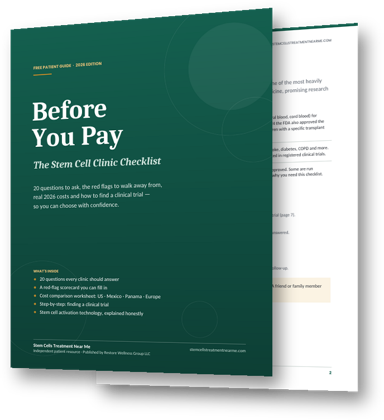
Before You Pay: The Stem Cell Clinic Checklist
- 20 questions every legitimate clinic should answer in writing
- A red-flag scorecard to spot unregulated marketing
- Realistic 2026 cost ranges: US, Mexico, Panama & Europe
- How to find a registered clinical trial
Medical Disclaimer: This article is for informational purposes only and does not constitute medical advice. Always consult a qualified medical professional before pursuing any treatment. See our full Medical Disclaimer.
Exploring your stem cell options? Use our free Clinic Finder to learn how to find and vet a legitimate stem cell clinic near you.