
One of the first questions patients ask when exploring stem cell therapy is: will my insurance cover it? The honest answer is that it depends — significantly — on what condition you have, what type of stem cell treatment is being proposed, and which insurer you have. This guide explains exactly what is and is not covered in 2026, how to appeal a denial, and what alternatives exist when insurance falls short.
What Insurance Does Cover
Insurance coverage for stem cell therapy is most reliable when the treatment is FDA-approved for a specific indication. The following are generally covered by Medicare and most major private insurers:
- Allogeneic bone marrow transplants for blood cancers including acute myeloid leukaemia (AML), acute lymphoblastic leukaemia (ALL), myelodysplastic syndrome (MDS) and severe aplastic anaemia
- Autologous stem cell transplants for multiple myeloma and certain lymphomas
- CAR-T cell therapies (Kymriah, Yescarta, Breyanzi, Abecma, Carvykti and others) for their FDA-approved indications in relapsed or refractory blood cancers
- Cord blood transplants for haematopoietic conditions in children and adults when a matched bone marrow donor is unavailable
For these established treatments, coverage is standard — though prior authorisation is required and the approval process can take two to four weeks.
What Insurance Does NOT Cover
The majority of stem cell treatments being offered at private regenerative medicine clinics — for conditions like knee arthritis, Parkinson’s disease, multiple sclerosis, COPD, autism spectrum disorder and general anti-aging — are classified as experimental or investigational by insurers and are not covered. This includes:
- Mesenchymal stem cell (MSC) injections for orthopedic conditions
- IV stem cell infusions for neurological disease
- Exosome therapy for any indication
- Platelet-rich plasma (PRP) for most conditions (covered for a narrow set of wound healing indications only)
- Stem cell activation patches and photobiomodulation devices
Insurers use the term “experimental” specifically because these treatments lack large-scale randomised controlled trials that demonstrate clinical effectiveness to FDA standard. This does not necessarily mean they are ineffective — it means the evidence base has not yet met the threshold insurers require.
How to Appeal an Insurance Denial
If your insurer has denied coverage for a stem cell treatment, you have legal rights under the Affordable Care Act to appeal. Here is how the process works:
- Request the denial in writing — ask for a written explanation citing the specific policy language and clinical criteria used to deny coverage
- Obtain a letter of medical necessity from your physician explaining why this specific treatment is appropriate for your specific condition
- File an internal appeal — insurers are legally required to review appeals within 30 days (or 72 hours for urgent cases)
- Request an independent external review — if the internal appeal fails, you can request review by an independent medical expert not employed by your insurer
- Contact your state insurance commissioner if the external review also fails — some states have additional protections for experimental treatment access
Appeals succeed more often than patients expect, particularly when supported by strong physician documentation and published clinical research supporting the proposed treatment.
Medicare and Medicaid
Medicare covers FDA-approved stem cell transplants and CAR-T therapies under Part A (hospital) and Part B (outpatient). Experimental treatments are not covered. Medicare Advantage plans follow similar rules but may have slightly different prior authorisation processes.
Medicaid coverage varies significantly by state. Bone marrow transplants are generally covered for qualifying diagnoses. Experimental treatments are almost never covered. Patients on Medicaid should speak directly with their state’s Medicaid office about coverage for specific procedures.
Financing Alternatives When Insurance Falls Short
When insurance will not cover treatment, patients typically explore:
- CareCredit — a healthcare credit card offering 0% financing for 12 to 24 months for qualifying purchases. Accepted at many stem cell clinics.
- Prosper Healthcare Lending — a medical loan provider offering fixed-rate personal loans for medical procedures not covered by insurance
- Clinic payment plans — many private clinics offer their own instalment arrangements, particularly for international providers
- HSA and FSA funds — Health Savings Accounts and Flexible Spending Accounts can be used for qualified medical expenses, which may include some stem cell treatments when prescribed by a physician
- Medical tourism — accessing equivalent treatment in Mexico, Panama or Germany at 40–70% lower cost
Find Verified Clinics Near You →
Prices and rules depend on where you are treated. See our location guides for Dallas, Miami, Los Angeles, Tijuana, Cancún, Panama City, the Bahamas and Germany — or browse all 20 location guides.
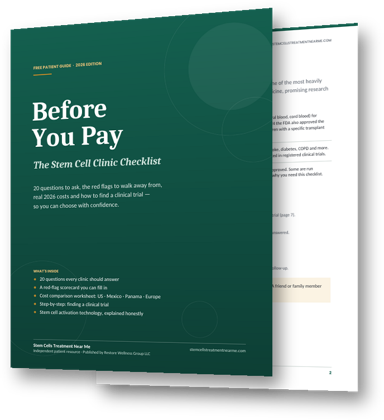
Before You Pay: The Stem Cell Clinic Checklist
- 20 questions every legitimate clinic should answer in writing
- A red-flag scorecard to spot unregulated marketing
- Realistic 2026 cost ranges: US, Mexico, Panama & Europe
- How to find a registered clinical trial
Medical Disclaimer: This article is for informational purposes only and does not constitute medical advice. Always consult a qualified medical professional before pursuing any treatment. See our full Medical Disclaimer.
Exploring your stem cell options? Use our free Clinic Finder to learn how to find and vet a legitimate stem cell clinic near you.