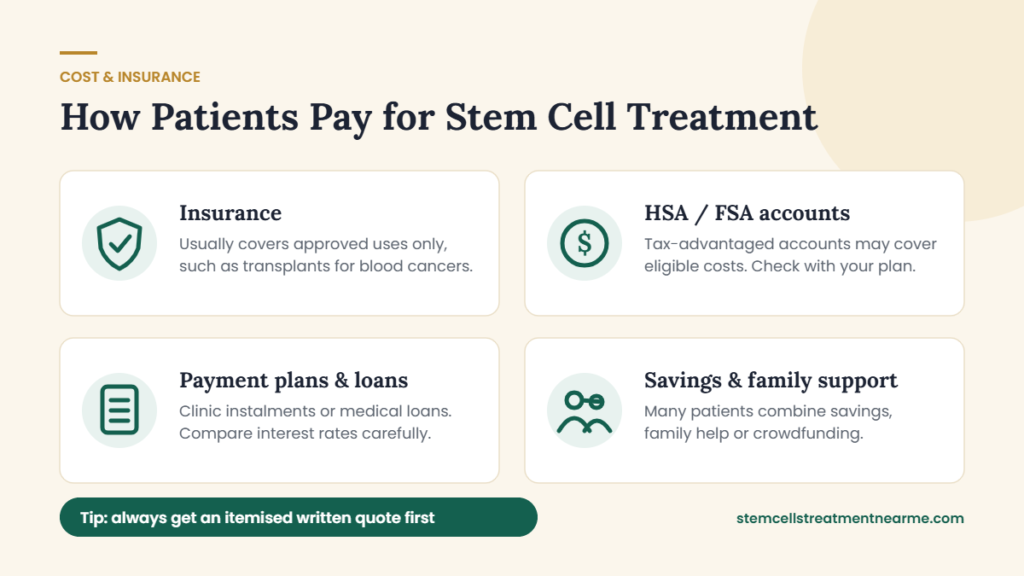
Stem cell therapy is one of the most promising developments in modern medicine — and one of the most expensive. For the many patients who are not candidates for the FDA-approved transplant procedures covered by insurance, the out-of-pocket cost of private stem cell treatment can feel like a barrier that puts the treatment permanently out of reach. This guide walks through every realistic financing option available to patients in 2026.
Why Financing Is Often Necessary
The majority of stem cell treatments offered at private regenerative medicine clinics — for conditions like knee arthritis, multiple sclerosis, Parkinson’s disease, COPD and autism — are classified as experimental by insurers and are not covered. Treatment costs in the US typically range from $5,000 for a single injection to $25,000 or more for a full systemic IV protocol. Most patients cannot pay this out of pocket in a single payment, making financing the practical path forward.
CareCredit — 0% Interest for 12 to 24 Months
CareCredit is a healthcare-specific credit card accepted at thousands of medical providers across the US, including a growing number of regenerative medicine clinics. The key benefit is promotional financing: 0% interest for 12, 18 or 24 months for qualifying purchases above a minimum threshold (typically $200).
To use CareCredit for stem cell treatment: first confirm your chosen clinic accepts it (call ahead — not all do), then apply online at carecredit.com. Approval is based on credit score and income. If approved, the full treatment cost can be charged to the card and paid off over the promotional period with no interest, provided you make minimum payments and pay the full balance before the promotional period ends.
Key warning: If the balance is not paid in full before the promotional period ends, deferred interest — calculated at the full regular APR (typically 26–29%) on the original balance — is charged immediately. Read the terms carefully.
Prosper Healthcare Lending — Fixed-Rate Medical Loans
Prosper Healthcare Lending is one of the largest dedicated medical loan providers in the US. Unlike CareCredit’s revolving credit model, Prosper offers fixed-rate personal loans with terms from 24 to 84 months. Interest rates vary based on creditworthiness — applicants with good to excellent credit (680+) typically qualify for rates of 7–15% APR.
Prosper does not require the clinic to be on their network, meaning the funds are deposited directly into your bank account and you pay the clinic directly. This gives more flexibility than CareCredit. Apply at prosperhealthcare.com.
Clinic Payment Plans
Many private stem cell clinics — particularly those in Mexico and Panama — offer their own in-house payment plans. These arrangements vary widely. Some clinics offer genuinely interest-free instalment arrangements; others charge a financing fee. Always get the payment plan terms in writing, including what happens if you need to cancel or defer treatment.
When evaluating clinic payment plans, ask: Is there interest? What is the cancellation policy? If I have a complication and cannot continue treatment, am I still obligated for the remaining instalments?
Personal Medical Loans
Standard personal loans from banks, credit unions and online lenders can be used for medical expenses. Interest rates are typically higher than Prosper Healthcare Lending for equivalent credit profiles, but the process can be faster and more straightforward. Credit unions often offer better rates than commercial banks for members in good standing.
Online lenders including LightStream, SoFi and Discover offer personal medical loans with competitive rates for borrowers with strong credit. Comparison shop across at least three lenders before applying — each application generates a hard credit inquiry, so complete your research before formally applying.
HSA and FSA Eligibility
Health Savings Accounts (HSAs) and Flexible Spending Accounts (FSAs) can be used to pay for qualified medical expenses. Whether stem cell therapy qualifies depends on how it is structured and whether it is prescribed by your physician as a medical treatment for a specific diagnosed condition.
Generally: if a licensed physician prescribes the treatment as medically necessary for a diagnosed condition, and you receive a detailed receipt from the clinic, HSA and FSA funds can be used. Anti-aging or wellness-focused treatments without a specific diagnosis are less likely to qualify. Consult your HSA/FSA plan administrator before assuming eligibility.
Questions to Ask Lenders Before Applying
- What is the total cost of the loan over the full term, including all interest and fees?
- Is there a prepayment penalty if I pay off the loan early?
- What is the monthly payment at the lowest and highest available interest rate?
- How long does approval and funding take?
- Does applying affect my credit score, and how?
A Note on International Treatment as a Cost Strategy
For patients who cannot afford US pricing even with financing, medical tourism — particularly to Mexico — can make treatment accessible at 40 to 60 percent lower cost. A treatment that costs $20,000 in the US may cost $8,000 in Tijuana or Cancun. At that price, even a modest personal loan or CareCredit plan can cover the full cost within a manageable repayment period.
Our Clinic Finder covers verified international providers and can help you compare costs transparently.
Find Affordable Verified Clinics →
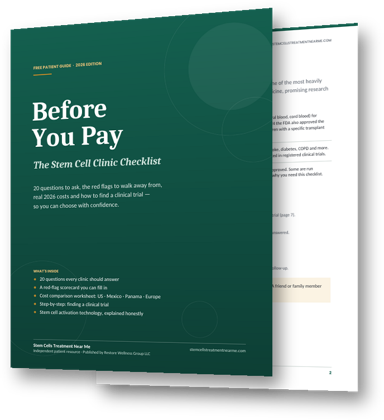
Before You Pay: The Stem Cell Clinic Checklist
- 20 questions every legitimate clinic should answer in writing
- A red-flag scorecard to spot unregulated marketing
- Realistic 2026 cost ranges: US, Mexico, Panama & Europe
- How to find a registered clinical trial
Medical Disclaimer: This article is for informational purposes only and does not constitute medical advice. Always consult a qualified medical professional before pursuing any treatment. See our full Medical Disclaimer.
Exploring your stem cell options? Use our free Clinic Finder to learn how to find and vet a legitimate stem cell clinic near you.