Imagine a future where a single treatment could correct the genetic root cause of a disease — not just manage the symptoms, but actually fix the underlying problem at the DNA level. That future is arriving faster than most people realize. In 2025, Harvard Medical School announced that the prestigious 2026 Warren Alpert Foundation Prize would be awarded to pioneering scientists whose work on gene-editing therapies is already changing lives. For patients between the ages of 40 and 75 who are exploring advanced treatment options — including stem cell therapy — this is news worth understanding.
What Is the Warren Alpert Foundation Prize?
The Warren Alpert Foundation Prize is one of the most respected awards in biomedical research. Administered in partnership with Harvard Medical School, it recognizes scientists whose discoveries have had a direct, meaningful impact on human health. Think of it as the medical world’s way of saying: “This research genuinely matters for patients.” Past recipients have gone on to receive Nobel Prizes, so when this award is given, the scientific community takes notice — and so should patients.
The 2026 prize was awarded specifically for breakthroughs in gene-editing therapies, a category of treatment that has enormous overlap with the regenerative medicine field that includes stem cell therapy. (Harvard Medical School)
What Is Gene Editing, and Why Does It Matter to You?
Gene editing sounds highly technical, but the basic idea is straightforward. Every cell in your body contains DNA — a kind of instruction manual that tells your body how to function. Sometimes those instructions contain errors, either from birth or due to disease. Gene-editing tools, most famously a technology called CRISPR-Cas9, act like a precise pair of molecular scissors that can find a specific section of faulty DNA and either cut it out or correct it.
From the Lab to Real Patients
What makes this award especially exciting is that gene-editing therapies are no longer just laboratory experiments. They are moving into clinical use. The U.S. Food and Drug Administration (FDA) approved the first CRISPR-based therapy in late 2023 for sickle cell disease — a painful, life-altering blood disorder. This approval marked a historic turning point, proving that rewriting human DNA is not science fiction. It is science fact.
For patients dealing with conditions like blood disorders, certain cancers, or inherited diseases, this progress represents real hope — not a distant promise, but a rapidly approaching reality.
How Does This Connect to Stem Cell Therapy?
You might be wondering: “I’m here to learn about stem cell therapy. Why does gene editing matter to me?” The answer is that these two fields are deeply intertwined and are increasingly being developed together.
A Powerful Partnership
Stem cells are the body’s raw building blocks — master cells that have the unique ability to develop into many different types of specialized cells, such as bone, muscle, nerve, or blood cells. Scientists have discovered that combining gene editing with stem cell therapy creates a remarkably powerful approach to treatment.
Here is how it works in practice: Stem cells are collected from a patient, gene-editing tools are used to correct or enhance those cells outside the body, and the improved cells are then returned to the patient. Because the corrected cells are the patient’s own, the risk of rejection is significantly reduced. This combined approach is already being used in trials for blood diseases, immune system disorders, and certain cancers.
What Conditions Might Benefit?
While research is ongoing and not all treatments are widely available yet, the conditions being studied for gene-editing and stem cell combination therapies include:
- Sickle cell disease and beta-thalassemia — blood disorders caused by genetic mutations
- Certain blood cancers, including leukemia and lymphoma
- Immune deficiency diseases — conditions where the immune system fails to protect the body properly
- Degenerative conditions that researchers believe may have genetic contributing factors
For patients in their 40s through 70s dealing with chronic or degenerative conditions, staying informed about these developments is genuinely worthwhile.
What This Means for Patients Today
It is important to be honest with you: not every gene-editing therapy is available today at your local clinic. Many treatments are still in clinical trials, and access depends heavily on your specific diagnosis, location, and health profile. However, here is what is true right now:
Progress Is Accelerating Rapidly
The recognition of gene-editing pioneers with a Harvard-affiliated prize signals that the scientific establishment views these therapies as proven, credible, and transformative. Funding, regulatory attention, and clinical expansion tend to follow that kind of validation. Treatments that are in trials today are likely to become standard options within the next several years.
Stem Cell Clinics Are Staying Current
Many forward-thinking regenerative medicine clinics are actively monitoring developments in gene editing and integrating the latest research into how they approach patient care. When you consult with a qualified stem cell clinic, asking about their awareness of gene-editing advances — and how those advances might apply to your treatment — is a smart and empowered question to ask.
You Deserve to Be Part of This Conversation
One of the most important things this prize announcement reinforces is that patients should not wait passively on the sidelines. Regenerative medicine — which includes both stem cell therapy and gene editing — is moving quickly. Being an informed, engaged patient means asking questions, seeking consultations, and understanding what options exist or are emerging for your specific condition.
A Word of Encouragement
Breakthroughs like the ones recognized by the 2026 Warren Alpert Foundation Prize remind us that medicine is not standing still. For anyone living with a chronic condition, persistent pain, or a disease that conventional medicine has struggled to address, the expanding world of regenerative medicine offers genuine reasons for hope. The science is real, the momentum is building, and patients who stay informed are the ones best positioned to benefit.
Talk to your doctor. Ask about clinical trials. And if you are curious about what stem cell therapy options exist near you today, we can help you take that next step.
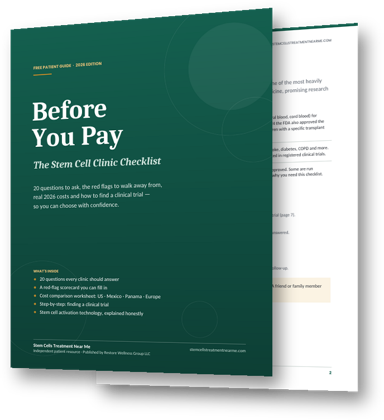
Before You Pay: The Stem Cell Clinic Checklist
- 20 questions every legitimate clinic should answer in writing
- A red-flag scorecard to spot unregulated marketing
- Realistic 2026 cost ranges: US, Mexico, Panama & Europe
- How to find a registered clinical trial
Keep reading
- What Is Stem Cell Therapy? A Plain-Language Guide for Patients
- How Much Does Stem Cell Therapy Cost in 2026?
- How to Find a Legitimate Stem Cell Clinic Near You
- Latest stem cell research and clinical trials
Medical Disclaimer: This article is for informational purposes only and does not constitute medical advice. Always consult a qualified medical professional before pursuing any treatment. See our full Medical Disclaimer.
Exploring your stem cell options? Use our free Clinic Finder to learn how to find and vet a legitimate stem cell clinic near you.