Every year, thousands of people travel abroad hoping that stem cell therapy will give them back something chronic illness or injury has taken away — their mobility, their independence, or simply a life with less pain. It’s an understandable choice. But a closer look at what Canadian patients have experienced when seeking stem cell treatments overseas reveals risks that are easy to overlook when hope is driving the decision. If you or someone you love is considering this path, here is what you genuinely need to know before booking a flight.
Why Patients Look Abroad for Stem Cell Therapy
Stem cell treatments that are not yet approved by Health Canada — or by the U.S. Food and Drug Administration — are often available in countries with less stringent medical oversight. Clinics in Mexico, Panama, Germany, Ukraine, and parts of Asia market aggressively to North American patients, often promising results for conditions ranging from multiple sclerosis and ALS to arthritis and Parkinson’s disease.
For many patients between the ages of 40 and 75, the appeal is straightforward: conventional medicine has offered limited relief, wait times for clinical trials are long, and the cost of doing nothing feels higher than the cost of trying something new. Clinics abroad often charge between $10,000 and $50,000 USD or more for these treatments — and most patients pay entirely out of pocket.
The Real Risks Canadian Patients Are Taking
According to reporting by Money.ca, Canadians who pursue stem cell treatments overseas face a layered set of risks that go well beyond the medical procedure itself.
Medical Risks That Can Follow You Home
One of the most significant concerns is that overseas clinics may use stem cells that have not been properly screened, matched, or processed. Unlike regulated clinical settings, some international providers use cells from unrelated donors (called allogeneic cells) without the rigorous testing that Canadian or American hospitals would require. This can lead to serious immune reactions, infections, or in rare cases, uncontrolled cell growth — a condition that can become life-threatening.
Even if a patient feels fine immediately after treatment, complications can emerge weeks or months later. When they return to Canada and seek care from their family doctor or a specialist, those physicians may have little information about what was actually administered, making it very difficult to treat side effects appropriately.
No Recourse If Something Goes Wrong
When a medical procedure causes harm in Canada, patients have access to regulatory bodies, professional oversight, and legal recourse. Overseas, those protections often disappear. Clinics operating in countries with limited medical regulation may not be licensed in any meaningful way. Contracts signed abroad are difficult — sometimes impossible — to enforce from Canada. Patients who experience complications are largely on their own.
Money.ca’s coverage highlights that some patients have returned home not only without improvement, but in worse health — and with no financial or legal path to compensation.
Financial Risks Are Significant
Travel, accommodation, the treatment itself, and follow-up care can add up quickly. Because these procedures are not covered by provincial health insurance plans, the entire financial burden falls on the patient. If complications arise after returning home, the cost of treating those complications may also come out of pocket — or may fall to the provincial health system, which can create additional friction with healthcare providers who are already skeptical of unproven treatments.
What Legitimate Stem Cell Therapy Looks Like
It is important to be clear: stem cell therapy is a real and rapidly advancing field of medicine. The issue is not with stem cells themselves, but with treatments that are offered outside of proper clinical and regulatory frameworks.
Approved and Investigational Treatments
Some stem cell therapies are already fully approved and widely used — bone marrow transplants for certain blood cancers being the most well-established example. A growing number of additional applications are being studied in registered clinical trials, where patients receive careful oversight, monitoring, and follow-up care at no cost.
If you are considering stem cell therapy for a condition like osteoarthritis, an autoimmune disorder, or a neurological condition, asking your doctor whether there are active clinical trials available to you is a meaningful first step. Databases like ClinicalTrials.gov list studies that are actively recruiting patients in Canada and the United States.
Questions to Ask Any Clinic
Whether you are considering a clinic in Canada, the U.S., or abroad, the following questions can help you assess whether a provider is operating responsibly:
- Is this treatment approved by a national regulatory body, or is it investigational?
- What type of stem cells will be used, and where do they come from?
- What testing and quality control is applied to the cells before treatment?
- What are the documented risks for my specific condition?
- What follow-up care is included, and what happens if I experience complications at home?
- Can you provide published peer-reviewed research supporting this treatment for my diagnosis?
A trustworthy provider will welcome these questions. A provider who deflects or pressures you to decide quickly is a warning sign.
What This Means for Patients Today
The hope that drives people toward overseas stem cell clinics is completely valid. Living with a chronic or degenerative condition is exhausting, and it makes sense to want to explore every option. What patients deserve, however, is access to honest information so that their hope is paired with real protection.
As stem cell science advances, more legitimate options are becoming available closer to home. The best outcomes in regenerative medicine come from treatments administered by qualified providers, using properly sourced and tested cells, with appropriate follow-up care. If you are researching stem cell therapy, start with verified clinics that operate within established regulatory guidelines — and take the time to ask hard questions before you commit.
Source: Money.ca, “Stem-cell treatments overseas: What Canadians risk.”
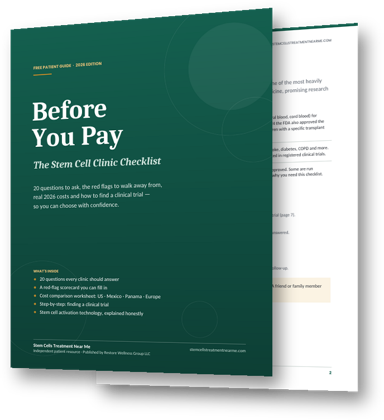
Before You Pay: The Stem Cell Clinic Checklist
- 20 questions every legitimate clinic should answer in writing
- A red-flag scorecard to spot unregulated marketing
- Realistic 2026 cost ranges: US, Mexico, Panama & Europe
- How to find a registered clinical trial
Keep reading
- What Is Stem Cell Therapy? A Plain-Language Guide for Patients
- How Much Does Stem Cell Therapy Cost in 2026?
- How to Find a Legitimate Stem Cell Clinic Near You
Medical Disclaimer: This article is for informational purposes only and does not constitute medical advice. Always consult a qualified medical professional before pursuing any treatment. See our full Medical Disclaimer.
Exploring your stem cell options? Use our free Clinic Finder to learn how to find and vet a legitimate stem cell clinic near you.