
Cost is the first question most patients ask — and the answer is almost always “it depends.” But that answer is not helpful when you are trying to plan. This guide gives you real price ranges by condition, treatment type, and country, so you can understand what stem cell therapy actually costs and what factors drive the price.
The Short Answer
Stem cell therapy in the United States ranges from approximately $3,000 for a single orthopaedic injection to $25,000 or more for a comprehensive systemic treatment programme. International clinics in Mexico and Panama typically offer comparable quality at 40–60% lower cost.
Cost by Treatment Type
Single Joint Injection (Knee, Hip, Shoulder)
This is the most accessible entry point for stem cell therapy. A single autologous injection — using cells drawn from your own bone marrow or fat tissue — typically costs:
- United States: $3,000 – $10,000 per joint
- Mexico (Tijuana/Cancun clinics): $1,500 – $4,000
- Panama: $2,500 – $5,000
Many patients with knee osteoarthritis or sports injuries start here. The procedure is usually outpatient, completed in a single visit, with minimal recovery time.
Systemic IV Infusion (Neurological / Autoimmune Conditions)
For conditions like MS, Parkinson’s, COPD, and autism, treatment typically involves intravenous infusion of mesenchymal stem cells (MSCs) — often combined with additional protocols. These are more comprehensive programmes:
- United States: $10,000 – $30,000 per programme
- Mexico: $5,000 – $15,000
- Germany (specialist clinics): $12,000 – $25,000
- Panama: $6,000 – $18,000
Bone Marrow Transplant (Cancer / Blood Disorders)
Haematopoietic stem cell transplantation for leukaemia, lymphoma, and myeloma is a different category entirely — longer, more complex, and hospital-based:
- United States: $100,000 – $300,000+ (largely covered by insurance for approved indications)
- India (leading centres): $15,000 – $30,000
What Drives the Price?
Several factors push costs up or down:
- Cell source: Autologous (your own cells) is generally less expensive than allogeneic (donor) cells, which require matching and processing
- Cell count: Higher cell doses cost more to prepare — and some clinics charge per million cells
- Number of sessions: Some conditions respond to a single treatment; others require repeated infusions over months
- Additional protocols: Hyperbaric oxygen, exosomes, PRP, and physical therapy are often added to treatment packages
- Location: US prices reflect higher labour costs, facility overhead, and liability insurance
Does Insurance Cover Stem Cell Therapy?
For most patients, the answer is no — with one important exception.
What insurance does cover: Haematopoietic stem cell transplantation (bone marrow transplant) for approved cancer indications is covered by most major insurance plans and Medicare. This is the exception, not the rule.
What insurance does not cover: Virtually all other stem cell therapies — including orthopaedic injections, systemic infusions for neurological conditions, and any treatment at international clinics — are considered experimental by insurers and are excluded from standard coverage.
Some patients have had partial success appealing insurance denials, particularly when a treating physician provides detailed documentation of medical necessity. This is difficult but not impossible for certain conditions.
Medical Tourism — Is It Worth It?
For patients who cannot afford US prices or whose condition is not being treated domestically, medical tourism is an increasingly mainstream option. Mexico in particular has developed a mature medical tourism infrastructure for stem cell therapy, with clinics in Tijuana, Monterrey, and Cancun attracting patients from across North America.
Key considerations for medical tourism:
- Research the clinic’s credentials and physician licensing carefully — not all clinics meet the same standard
- Factor in travel, accommodation, and any follow-up costs into the total budget
- Ensure you have a follow-up plan with a domestic physician after returning home
- Look for clinics that publish their protocols and outcomes independently, not just patient testimonials on their own website
Financing Options
Because most stem cell therapy is not covered by insurance, many clinics offer financing. Common options include:
- CareCredit (medical financing at 0% for 12–24 months in many cases)
- Prosper Healthcare Lending
- Direct clinic payment plans (typically 3–6 month terms)
- Personal loans through banks or credit unions
A Note on At-Home Wellness Products
You may also see at-home wellness products, such as phototherapy patches, marketed to support the body’s own repair processes. These are general wellness products — not a medical treatment and not a lower-cost substitute for clinical care for any disease. If you are considering stem cell therapy for a diagnosed condition, discuss evidence-based options with your doctor. We cover wellness topics separately in our At-Home Wellness & Phototherapy section, with our disclosure.
Getting a Real Quote
The best way to get accurate pricing for your specific condition is to contact clinics directly with your medical history and ask for a detailed written treatment proposal — including exactly which cells, what dose, how many sessions, and what is included in the package price.
Use our free Clinic Finder to learn how to vet providers who will give you a transparent cost breakdown without pressure.
Prices and rules depend on where you are treated. See our location guides for Dallas, Miami, Los Angeles, Tijuana, Cancún, Panama City, the Bahamas and Germany — or browse all 20 location guides.
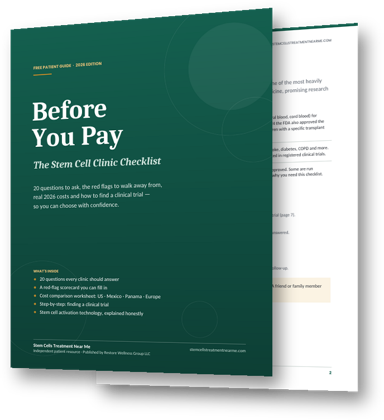
Before You Pay: The Stem Cell Clinic Checklist
- 20 questions every legitimate clinic should answer in writing
- A red-flag scorecard to spot unregulated marketing
- Realistic 2026 cost ranges: US, Mexico, Panama & Europe
- How to find a registered clinical trial
Medical Disclaimer: Pricing information in this article is based on publicly available data and patient-reported costs as of 2026. Actual costs vary by clinic, condition, and individual treatment plan. This article does not constitute financial or medical advice. Always consult a qualified medical professional and request detailed written quotes from any clinic you are considering. See our full Medical Disclaimer.Stem Cell Therapy Cost by Country (2026)
| Country | Typical private price (USD) | Regulator |
|---|---|---|
| United States (national) | $1,200 – $28,000 | FDA (federal) + some state laws |
| Mexico | $2,000 – $20,000 | COFEPRIS |
| Panama | $5,000 – $50,000 | Ministry of Health (MINSA) |
| Costa Rica | $3,500 – $50,000 | Ministry of Health |
| Colombia (Medellín) | $2,500 – $20,000 | INVIMA |
| The Bahamas | $5,000 – $60,000 | National regulatory board (2024 Act) |
| Germany | $2,300 – $23,000 | Paul-Ehrlich-Institut / EMA |
| Switzerland | $9,000 – $40,000 | Swissmedic |
| Serbia (Belgrade) | $3,500 – $30,000 | Ministry of Health / ALIMS |
| Turkey (Istanbul) | $1,800 – $15,000 | Ministry of Health / TİTCK |
Indicative ranges from published sources, from a single joint injection (low end) to multi-session programmes (high end). Always get an itemised written quote. Compare destinations side by side: Mexico vs USA · Panama vs Mexico · all location guides.
>