Imagine being told you have a disease with no known cure — one that, on average, takes a person’s life within two to five years of diagnosis. Now imagine defying those odds, living far beyond what any doctor predicted, and crediting stem cell therapy as a key part of your survival story. For one ALS patient featured by Nashville’s WZTV, that isn’t a hypothetical. It’s real life. And for the millions of people living with or loving someone affected by ALS, this kind of story deserves a closer, careful look.
What Is ALS and Why Is It So Difficult to Treat?
ALS stands for Amyotrophic Lateral Sclerosis, but you may know it better as Lou Gehrig’s disease. It’s a progressive neurological condition — meaning it gets worse over time — that attacks the nerve cells responsible for controlling your muscles. Over months and years, people with ALS gradually lose the ability to move, speak, swallow, and eventually breathe.
Here’s the hard truth: there is currently no cure for ALS. The FDA has approved a handful of medications that can slow progression slightly, but none of them stop the disease in its tracks. The average survival after diagnosis is just two to five years, though roughly 10% of patients live ten years or more. That makes every story of extended survival worth paying attention to.
One Patient’s Remarkable Journey
According to the report from WZTV, an ALS patient who pursued stem cell therapy has now lived well beyond the typical life expectancy associated with the disease. While individual patient outcomes can never be used to predict results for others, the story is striking — and it raises a question that many patients and families are now asking: could stem cell therapy play a meaningful role in managing ALS?
The patient in the WZTV report credited stem cell treatments as part of the reason for their extended survival and maintained quality of life. This is significant not just emotionally, but because it adds to a growing body of anecdotal evidence and early-stage research suggesting that stem cell approaches may offer benefits for some ALS patients that traditional medicine simply cannot.
Why Stem Cells? What Are They Actually Doing?
Stem cells are often called the body’s “master cells” because they have the unique ability to develop into many different types of specialized cells. In the context of ALS and other neurological diseases, researchers and clinicians are exploring how stem cells might help in several ways:
- Neuroprotection: Some stem cells release growth factors and anti-inflammatory proteins that may help protect existing motor neurons — the nerve cells being destroyed by ALS — from further damage.
- Reducing inflammation: Chronic inflammation in the nervous system is believed to speed up ALS progression. Certain types of stem cells, particularly mesenchymal stem cells (MSCs), have natural anti-inflammatory properties that could help slow this process.
- Potential cell replacement: While still largely experimental, researchers are investigating whether stem cells can eventually replace damaged nerve cells, though this remains one of the more complex goals.
What Does the Research Say So Far?
It’s important to be transparent: stem cell therapy for ALS is still considered experimental. No stem cell treatment has received full FDA approval specifically for ALS at this time. However, the research landscape is genuinely encouraging.
Clinical trials are underway at leading institutions studying how different types of stem cells — including mesenchymal stem cells derived from bone marrow or fat tissue, and neural stem cells — affect ALS progression. Several early-phase trials have shown that these treatments appear to be safe and well-tolerated. Some have also shown signals of potential benefit in slowing disease progression, though larger studies are still needed to confirm these findings.
The Importance of Being an Informed Patient
Stories like the one reported by WZTV are genuinely hopeful — and hope matters enormously when you or someone you love is facing a diagnosis like ALS. At the same time, it’s critical to approach stem cell therapy with clear eyes and good information.
Not every clinic offering stem cell treatments operates with the same standards of care, transparency, or scientific rigor. As a patient or caregiver, here are some important questions to ask before pursuing any treatment:
- What type of stem cells are being used, and where do they come from?
- Is the clinic conducting or participating in registered clinical trials?
- What specific outcomes has this clinic seen with ALS patients?
- What are the potential risks and side effects of the procedure?
- What is the total cost, and what is included?
What This Means for ALS Patients Considering Stem Cell Therapy Today
For patients and families navigating an ALS diagnosis, the WZTV report is a reminder that the boundaries of what is medically possible are not always fixed. While no treatment can guarantee results like those seen in that patient’s story, the growing interest in and early evidence around stem cell therapy means it is a legitimate conversation to have with your neurologist or ALS care team.
Many patients are choosing to explore stem cell therapy in combination with standard-of-care treatments — not as a replacement, but as a complement. This integrative approach, pursued under the guidance of qualified medical professionals, is becoming more common as both patients and physicians seek every available option.
Taking the Next Step
If you or someone you love is living with ALS and you’re curious about whether stem cell therapy could be part of your care plan, the most important first step is finding a reputable, experienced clinic and speaking with your existing medical team. The right support and information can make all the difference in navigating this complex but increasingly promising area of medicine.
Stories like the one from WZTV don’t offer guarantees — but they do offer something just as valuable: proof that for some patients, the journey doesn’t have to end where the statistics say it should.
Source: Stem Cell Therapy helps ALS patient live beyond all normal expectations — WZTV
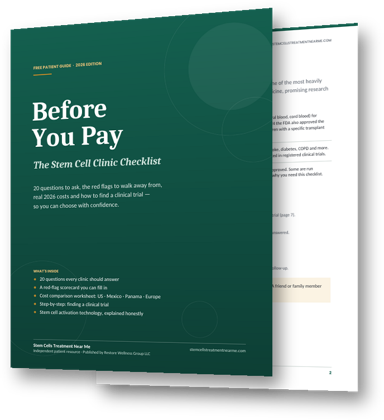
Before You Pay: The Stem Cell Clinic Checklist
- 20 questions every legitimate clinic should answer in writing
- A red-flag scorecard to spot unregulated marketing
- Realistic 2026 cost ranges: US, Mexico, Panama & Europe
- How to find a registered clinical trial
Keep reading
- What Is Stem Cell Therapy? A Plain-Language Guide for Patients
- How Much Does Stem Cell Therapy Cost in 2026?
- How to Find a Legitimate Stem Cell Clinic Near You
- More conditions being treated with stem cells
Medical Disclaimer: This article is for informational purposes only and does not constitute medical advice. Always consult a qualified medical professional before pursuing any treatment. See our full Medical Disclaimer.
Exploring your stem cell options? Use our free Clinic Finder to learn how to find and vet a legitimate stem cell clinic near you.