If you have ever wondered whether getting older means simply accepting more pain, less mobility, and a gradual decline in the quality of your life, you are not alone. Millions of people between the ages of 40 and 75 are asking the same question — and science may finally be offering some genuinely hopeful answers. A recent report from New Scientist explores whether stem cell therapy is on the verge of transforming medicine as we know it, and even reversing some of the biological processes we associate with aging. Here is what that means for real patients like you, right now.
What Is Stem Cell Therapy, and Why Is Everyone Talking About It?
Stem cells are often described as the body’s raw material — the foundational cells from which all other specialized cells are created. Think of them like a master key that can potentially unlock the door to repairing damaged tissue, reducing inflammation, and restoring function in parts of the body that have worn down over time.
What makes stem cells especially exciting to researchers is their ability to self-renew (make more copies of themselves) and differentiate (transform into specific types of cells, such as cartilage, muscle, or nerve cells). When introduced into a damaged area of the body, they may help kickstart the body’s own natural healing processes.
According to the New Scientist report, scientists are increasingly optimistic that we are approaching a turning point — a moment when stem cell therapies move from the laboratory into mainstream clinical medicine in a meaningful way.
Could Stem Cells Actually Slow or Reverse Aging?
This is the question that is generating the most excitement — and the most caution — among researchers. The short answer is: possibly, and scientists are working hard to understand exactly how and for whom.
The Biological Connection Between Stem Cells and Aging
As we age, our body’s own supply of stem cells naturally declines in both number and effectiveness. This is one reason why a 65-year-old heals from an injury more slowly than a 25-year-old. The tissues simply do not have as many high-functioning stem cells available to do the repair work.
Researchers are now investigating whether introducing fresh, healthy stem cells into the body could compensate for this decline — essentially giving aging tissues a younger toolkit to work with. Some early-stage studies have shown promising signs that this approach can reduce markers of inflammation and cellular aging, though experts are careful to stress that large-scale clinical trials are still ongoing.
What the Science Says Right Now
According to the New Scientist coverage, several research teams are focusing on a class of stem cells called mesenchymal stem cells (MSCs) — a term that simply refers to multipotent cells (cells that can become multiple cell types) often sourced from bone marrow, fat tissue, or umbilical cord tissue. These cells have shown particular promise in reducing inflammation, which is increasingly understood to be a root driver of many age-related conditions including arthritis, heart disease, and cognitive decline.
Some researchers are also exploring induced pluripotent stem cells (iPSCs) — adult cells that have been reprogrammed back to a more youthful, stem-like state. While this technology is still largely experimental, it represents a potentially revolutionary path toward personalized, age-reversing treatments.
What Could This Mean for Patients Today?
It is important to be honest with you: we are not yet in a world where a single stem cell treatment will erase decades of aging overnight. However, that does not mean there is nothing meaningful available to patients right now.
Conditions Being Treated With Stem Cell Therapy Today
Many clinics are currently offering stem cell therapies for a range of conditions that disproportionately affect people in their 40s through 70s, including:
- Osteoarthritis and joint pain — one of the most studied applications, with many patients reporting reduced pain and improved mobility
- Back and spine conditions — including degenerative disc disease
- Autoimmune conditions — where the immune system attacks the body’s own tissues
- Recovery support after orthopedic injuries
- General wellness and anti-aging protocols — designed to address fatigue, inflammation, and age-related decline
Realistic Expectations: Hope Grounded in Honesty
The most trustworthy clinics will always be upfront with you: stem cell therapy is not a guaranteed cure, and results vary from person to person depending on age, overall health, the condition being treated, and the type of stem cells used. What it can offer for many patients is a complementary approach — one that works alongside conventional medicine rather than replacing it — with the potential to address underlying causes of pain and decline rather than simply managing symptoms.
What Should You Do Before Pursuing Stem Cell Therapy?
Ask the Right Questions
Before committing to any treatment, always ask a clinic:
- What type of stem cells are used, and where do they come from?
- Is this treatment part of a registered clinical trial or approved protocol?
- What results have previous patients with my condition experienced?
- What are the potential risks or side effects?
- How many treatments might I need?
Work With Your Own Doctor
Always discuss your interest in stem cell therapy with your primary care physician or specialist before moving forward. A good clinic will welcome that conversation and be willing to coordinate with your existing healthcare team.
The Bottom Line: A Genuinely Exciting Moment in Medicine
The New Scientist report captures what many in the research community are feeling right now — a sense that we are standing at the edge of something remarkable. Stem cell science is advancing rapidly, and the potential to not just treat disease but to meaningfully address the biology of aging is no longer science fiction. For patients in their 40s, 50s, 60s, and 70s, that is genuinely encouraging news. The key is staying informed, asking good questions, and working with reputable, transparent providers who put your health and safety first.
Source: Is stem cell therapy about to transform medicine and reverse ageing? — New Scientist
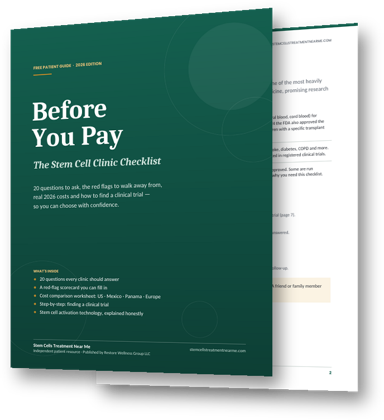
Before You Pay: The Stem Cell Clinic Checklist
- 20 questions every legitimate clinic should answer in writing
- A red-flag scorecard to spot unregulated marketing
- Realistic 2026 cost ranges: US, Mexico, Panama & Europe
- How to find a registered clinical trial
Keep reading
- What Is Stem Cell Therapy? A Plain-Language Guide for Patients
- How Much Does Stem Cell Therapy Cost in 2026?
- How to Find a Legitimate Stem Cell Clinic Near You
Medical Disclaimer: This article is for informational purposes only and does not constitute medical advice. Always consult a qualified medical professional before pursuing any treatment. See our full Medical Disclaimer.
Exploring your stem cell options? Use our free Clinic Finder to learn how to find and vet a legitimate stem cell clinic near you.