If someone you love has been diagnosed with Alzheimer’s disease, you know how devastating it feels to watch the condition slowly take more and more away. For decades, patients and families have been told there is very little that can stop the progression. But a new investigational study out of the University of Miami is offering something rare in the world of Alzheimer’s care: genuine hope. Researchers are now exploring whether stem cell therapy could help stabilize the disease — not just manage symptoms, but potentially slow or halt the damage at its source.
What Is This New Research About?
Scientists at the University of Miami are conducting an investigational study examining whether stem cell therapy can stabilize the progression of Alzheimer’s disease. While the research is still in its early clinical stages, the approach represents a meaningful shift in how doctors and researchers are thinking about this condition — moving from symptom management toward targeting the underlying biology of the disease itself.
The study is part of a broader movement in regenerative medicine that looks at stem cells not just as a tool for physical injuries or joint pain, but as a potential intervention in neurological conditions that affect the brain and memory.
Why Is This Significant?
Alzheimer’s disease affects an estimated 6.7 million Americans age 65 and older, according to the Alzheimer’s Association. Most currently approved treatments focus on slowing cognitive decline or managing behavioral symptoms — they do not stop the progression of the disease. The idea that stem cells might be able to stabilize the condition is a major step forward in thinking about long-term care options for patients and their families.
How Could Stem Cells Help With Alzheimer’s?
To understand why researchers are excited about this approach, it helps to know a little about what Alzheimer’s does to the brain. The disease causes a buildup of abnormal protein clusters — called amyloid plaques and tau tangles — that damage and destroy brain cells over time. This leads to the memory loss, confusion, and behavioral changes that families know all too well.
Stem cells are unique because they have the ability to develop into many different types of cells in the body, including brain cells. They also have powerful anti-inflammatory properties and can release growth factors that support the survival of existing cells. In the context of Alzheimer’s, researchers believe stem cells may be able to:
- Reduce inflammation in the brain, which plays a major role in disease progression
- Support the survival of existing neurons (brain cells) that have not yet been destroyed
- Potentially promote the growth of new neural connections
- Create a more protective environment in the brain that slows further damage
The goal in the University of Miami investigation is not necessarily to reverse damage that has already occurred, but to create a biological environment in which the disease stops advancing as aggressively — a concept researchers call stabilization.
What Type of Stem Cells Are Being Studied?
While the full details of the University of Miami protocol are still emerging, investigational Alzheimer’s stem cell studies in general tend to focus on mesenchymal stem cells (MSCs) — a type of adult stem cell that can be harvested from sources like bone marrow, fat tissue, or umbilical cord tissue. MSCs are known for their strong anti-inflammatory effects and their ability to modulate the immune system, both of which are relevant in Alzheimer’s disease.
What Does This Mean for Patients Right Now?
It is important to be honest with patients and families: this research is investigational, meaning it has not yet been approved by the U.S. Food and Drug Administration (FDA) as a standard treatment for Alzheimer’s disease. Clinical trials are the necessary pathway through which any new therapy must prove it is safe and effective before it becomes widely available.
However, what this research signals is significant. It tells us that major academic medical institutions are taking stem cell therapy seriously as a potential option for Alzheimer’s patients. It tells us that the science is advancing. And it tells us that for patients and families who feel like they are running out of options, there is real scientific activity happening on their behalf.
Should You Consider a Clinical Trial?
If you or a loved one is living with Alzheimer’s disease, participating in a clinical trial may be worth exploring. Clinical trials give patients access to cutting-edge treatments before they are available to the general public, often at no cost. They are conducted under rigorous safety protocols, and they directly contribute to the research that could help future patients as well.
You can search for active Alzheimer’s stem cell trials through ClinicalTrials.gov, the official U.S. government database of clinical studies. A neurologist or primary care physician familiar with your case can help you evaluate whether a trial might be appropriate for your specific situation.
The Bigger Picture: Stem Cells and Brain Health
The University of Miami’s investigation into Alzheimer’s is part of a growing body of research examining the role of stem cell therapy across a wide range of neurological conditions, including Parkinson’s disease, multiple sclerosis, and stroke recovery. As researchers learn more about how stem cells interact with the brain and nervous system, the potential applications are continuing to expand.
For patients between the ages of 40 and 75 who are watching their own cognitive health or supporting a loved one with Alzheimer’s, this is a moment to stay informed, stay engaged with your medical team, and keep an eye on the science as it develops. The road from promising research to approved therapy takes time — but the direction is encouraging.
Talking to Your Doctor
If you are interested in stem cell therapy for Alzheimer’s disease or any other condition, the most important first step is an honest conversation with a qualified physician. Ask about clinical trials in your area, ask what your current treatment options are, and ask what questions you should be monitoring as this research progresses. An informed patient is always in the best position to make good decisions.
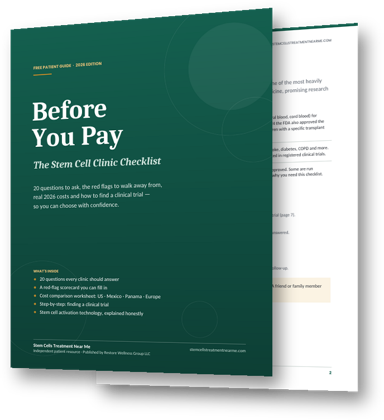
Before You Pay: The Stem Cell Clinic Checklist
- 20 questions every legitimate clinic should answer in writing
- A red-flag scorecard to spot unregulated marketing
- Realistic 2026 cost ranges: US, Mexico, Panama & Europe
- How to find a registered clinical trial
Keep reading
- What Is Stem Cell Therapy? A Plain-Language Guide for Patients
- How Much Does Stem Cell Therapy Cost in 2026?
- How to Find a Legitimate Stem Cell Clinic Near You
- More conditions being treated with stem cells
Medical Disclaimer: This article is for informational purposes only and does not constitute medical advice. Always consult a qualified medical professional before pursuing any treatment. See our full Medical Disclaimer.
Exploring your stem cell options? Use our free Clinic Finder to learn how to find and vet a legitimate stem cell clinic near you.