If you or someone you love has been living with multiple sclerosis — trying medication after medication with little relief — you may have wondered whether there is anything left to try. For many patients with treatment-resistant MS, that feeling of running out of options is all too real. But a groundbreaking clinical trial now underway at the University of Miami is offering new hope. The Beat-MS trial is testing whether stem cell therapy can do what conventional drugs have not: stop the disease in its tracks and give patients their lives back.
What Is the Beat-MS Trial?
The Beat-MS trial (which stands for “Best Available Therapy versus Autologous Hematopoietic Stem Cell Transplant for Multiple Sclerosis”) is a federally funded clinical study being conducted at the University of Miami and other major research centers across the United States. Its goal is to find out whether a specific type of stem cell therapy — called hematopoietic stem cell transplantation, or HSCT — works better than the best available drug treatments for people whose MS has not responded well to standard medications.
This is not a small or early-stage experiment. The Beat-MS trial is one of the largest and most carefully designed MS stem cell studies ever conducted in the United States, and its results could change how doctors approach treatment-resistant MS for years to come.
Source: University of Miami News
How Does This Type of Stem Cell Therapy Work?
If you are not familiar with HSCT, here is a simple way to understand it. Think of your immune system like a computer that has developed a serious virus. Instead of trying to patch it over and over, HSCT essentially wipes the hard drive and reinstalls a clean version.
Step 1: Collecting Your Own Stem Cells
Doctors begin by collecting blood-forming stem cells from the patient’s own body — usually from the bloodstream. These are the “clean” building blocks that will eventually rebuild a healthy immune system. Because the cells come from the patient themselves, this is called an autologous (aw-TAH-luh-gus) transplant, meaning self-donated.
Step 2: Resetting the Immune System
Next, the patient receives chemotherapy to eliminate the malfunctioning immune cells that have been attacking the nervous system. In MS, the immune system mistakenly targets the protective covering around nerve fibers, called myelin. By clearing out these damaged immune cells, the therapy removes the source of ongoing destruction.
Step 3: Rebuilding From Scratch
The previously collected stem cells are then returned to the patient’s body through an infusion, similar to a blood transfusion. These stem cells travel to the bone marrow and begin generating a fresh, healthy immune system — one that, ideally, no longer attacks the patient’s own nervous system.
Who Is This Trial For?
The Beat-MS trial specifically focuses on patients with relapsing forms of MS who have continued to experience relapses or new MRI activity despite being treated with high-efficacy MS medications. In other words, this is for people whose MS has not been controlled by standard drug therapies — a group that has historically had very few options remaining.
If you fall into this category, you are not alone. A meaningful percentage of people living with MS find that even the strongest available medications do not fully stop disease activity. For these individuals, the idea of a therapy that could fundamentally reset the immune system is not just medically exciting — it is deeply personal.
What Are Researchers Hoping to Find?
The primary question the Beat-MS trial is asking is straightforward: does HSCT lead to better long-term outcomes than the current best drug therapies for treatment-resistant MS? Researchers will be tracking patients over several years, looking at things like:
- How often patients experience relapses
- Whether disability levels improve, stay stable, or worsen
- Changes visible on MRI brain and spinal cord scans
- Quality of life and the ability to perform daily activities
- Safety and tolerability of the treatment
Because this is a randomized trial — meaning patients are assigned by chance to either the stem cell group or the best available drug therapy group — the results will carry a high level of scientific credibility.
What This Means for Patients Today
You might be reading this and thinking: “This sounds promising, but what does it mean for me right now?” That is a fair and important question.
Clinical Trial Participation
If you have relapsing MS that has not responded to standard treatments, you may be eligible to participate in the Beat-MS trial or a similar study. Enrolling in a clinical trial gives you access to cutting-edge care under close medical supervision, often at no cost to you. Your doctor or a specialist at a participating medical center can help you determine if you qualify.
Stem Cell Clinics Offering HSCT Outside of Trials
Outside of clinical trials, some accredited clinics already offer HSCT and other stem cell therapies to MS patients who meet certain criteria. While these treatments are not yet universally approved as a first-line MS therapy in the United States, they are being performed with growing frequency and with an improving safety record. It is essential that you seek care from a reputable, medically supervised clinic if you pursue this route.
Stay Informed as the Science Evolves
The Beat-MS trial results are expected to have far-reaching influence on how neurologists and MS specialists approach difficult-to-treat cases. As data becomes available, treatment guidelines could shift meaningfully — potentially bringing HSCT into the mainstream conversation for a much larger group of MS patients.
A Word of Encouragement
Living with a condition like MS — especially when treatments have not worked the way you hoped — can be exhausting and discouraging. But the fact that leading researchers at institutions like the University of Miami are investing deeply in stem cell approaches for treatment-resistant MS is a genuine sign of progress. Science is moving in a direction that could bring real relief to thousands of people who have been waiting for something better. You deserve to stay informed, ask questions, and explore every option available to you.
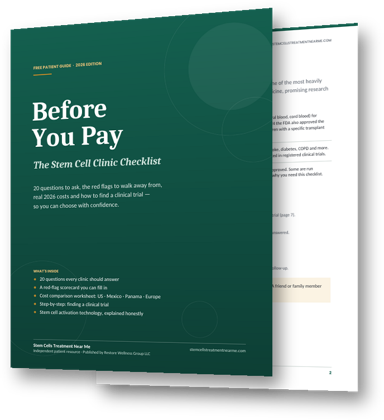
Before You Pay: The Stem Cell Clinic Checklist
- 20 questions every legitimate clinic should answer in writing
- A red-flag scorecard to spot unregulated marketing
- Realistic 2026 cost ranges: US, Mexico, Panama & Europe
- How to find a registered clinical trial
Keep reading
- What Is Stem Cell Therapy? A Plain-Language Guide for Patients
- How Much Does Stem Cell Therapy Cost in 2026?
- How to Find a Legitimate Stem Cell Clinic Near You
Medical Disclaimer: This article is for informational purposes only and does not constitute medical advice. Always consult a qualified medical professional before pursuing any treatment. See our full Medical Disclaimer.
Exploring your stem cell options? Use our free Clinic Finder to learn how to find and vet a legitimate stem cell clinic near you.