If you or someone you love has been diagnosed with acute myeloid leukemia (AML) that has come back after treatment — or simply hasn’t responded to standard therapies — you know how frightening and exhausting that journey can be. The good news is that researchers are not giving up. A groundbreaking new form of cell-based therapy is showing real promise, even for patients who have already been through a bone marrow transplant. Here’s what you need to know in plain, straightforward terms.
What Is CAR T-Cell Therapy, and Why Does It Matter?
CAR T-cell therapy stands for Chimeric Antigen Receptor T-cell therapy. That’s a mouthful, so let’s break it down simply. Your immune system has special fighter cells called T-cells. Scientists can take some of those T-cells from your body, re-engineer them in a laboratory to recognize and attack cancer cells specifically, and then infuse them back into your body. Think of it like giving your immune system a custom-built targeting system — one that’s been programmed to seek out and destroy cancer cells while largely leaving healthy cells alone.
This approach has already been approved for certain blood cancers like some forms of lymphoma and leukemia in children. But until recently, it has been much harder to make work for AML — one of the most aggressive and difficult-to-treat forms of leukemia in adults.
The Challenge With AML
AML is a cancer that starts in the bone marrow, the spongy tissue inside your bones where blood cells are made. It moves fast, and while many patients respond well to initial chemotherapy, a significant number see the disease return. When AML comes back — a situation doctors call “relapsed” — or when it never fully responded to treatment in the first place (“refractory”), options become much more limited. This is the patient population that this new CAR T-cell therapy is targeting.
Why Previous Treatments Have Fallen Short
Traditional chemotherapy can be hard on the body, especially for patients in their 40s, 50s, 60s, and beyond. Bone marrow transplants (also called stem cell transplants) offer a potential cure but come with serious risks and are not always successful. When the cancer returns even after a transplant, many patients and families feel like they’ve run out of options. That’s exactly why this new research is so meaningful.
What Roswell Park Researchers Found
According to a report from Roswell Park Comprehensive Cancer Center, a new CAR T-cell therapy is showing significant promise as what researchers are calling a potential “magic bullet” for patients with relapsed or refractory AML — and remarkably, it appears to hold promise even for those who have already undergone a bone marrow transplant and seen the disease return.
This is a big deal. It means the therapy may be able to reach patients at a stage where, in the past, very few effective treatments existed. Researchers at Roswell Park, a leading cancer center in Buffalo, New York, are at the forefront of this work, bringing new hope to a patient group that desperately needs it.
Why They’re Calling It a “Magic Bullet”
The phrase “magic bullet” in medicine refers to a treatment that precisely targets the disease with minimal harm to the rest of the body. That’s the ideal that CAR T-cell therapy is chasing — and in early results for this new AML-specific version, scientists are seeing encouraging signs that it can zero in on AML cells with that kind of precision. This is especially important for older patients or those weakened by prior treatments, who may not be able to tolerate aggressive chemotherapy regimens.
How This Connects to Stem Cell Therapy
You may wonder what CAR T-cell therapy has to do with stem cells. The connection is closer than you might think. Bone marrow transplants — which are a well-established form of stem cell therapy — are often the recommended treatment before a patient reaches the relapsed stage. When those transplants don’t deliver lasting results, CAR T-cell therapy may now offer a next step. Both approaches work by harnessing the body’s own cellular machinery to fight disease, which is why advances in one field often inform and inspire progress in the other.
What This Means for Patients Considering Cell-Based Treatments
If you or a family member is navigating a blood cancer diagnosis, here are a few key takeaways from this research:
- More options may be available than your current care team has discussed, especially at specialized cancer centers.
- Clinical trials are worth asking about. Many cutting-edge therapies like this one are available through clinical trials before they receive full FDA approval.
- Specialized centers matter. Facilities like Roswell Park have dedicated research programs and access to therapies that may not be available at every hospital.
- Cell-based therapies are evolving rapidly. What wasn’t possible two or three years ago may be possible today.
Questions to Ask Your Doctor
If this research resonates with your situation, consider bringing these questions to your next medical appointment:
- Am I a candidate for CAR T-cell therapy or any related clinical trials?
- Has my AML been tested for the specific markers that this therapy targets?
- Should I seek a second opinion at a comprehensive cancer center?
- What cell-based treatment options are currently available for my stage and type of AML?
Looking Ahead With Cautious Optimism
Research like this from Roswell Park is a reminder that even in the most difficult cancer cases, science is actively working to find new answers. For patients aged 40 to 75 who are dealing with relapsed or treatment-resistant AML, this is a genuinely hopeful development. It won’t be the right fit for everyone, and it’s still moving through research and clinical trial stages — but it represents real progress toward treatments that are more targeted, more precise, and potentially more tolerable than what has existed before.
Cell-based therapies are no longer just a distant promise. They are an active and growing part of modern cancer care, and staying informed puts you in a better position to advocate for yourself or your loved one.
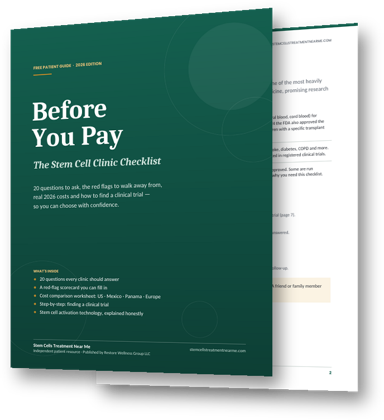
Before You Pay: The Stem Cell Clinic Checklist
- 20 questions every legitimate clinic should answer in writing
- A red-flag scorecard to spot unregulated marketing
- Realistic 2026 cost ranges: US, Mexico, Panama & Europe
- How to find a registered clinical trial
Keep reading
- What Is Stem Cell Therapy? A Plain-Language Guide for Patients
- How Much Does Stem Cell Therapy Cost in 2026?
- How to Find a Legitimate Stem Cell Clinic Near You
- More conditions being treated with stem cells
Medical Disclaimer: This article is for informational purposes only and does not constitute medical advice. Always consult a qualified medical professional before pursuing any treatment. See our full Medical Disclaimer.
Exploring your stem cell options? Use our free Clinic Finder to learn how to find and vet a legitimate stem cell clinic near you.