
If you or someone you love has been diagnosed with spinocerebellar ataxia, you know how difficult it can be to watch coordination and balance slowly decline — and how desperately the medical community has needed new treatment options. That’s why a recent announcement out of Japan is giving many patients and families a genuine reason for hope. A biotechnology company called REPROCELL has officially submitted an application in Japan to gain approval to manufacture and market a stem cell therapy called Stemchymal®, specifically designed to treat two forms of spinocerebellar ataxia: SCA3 and SCA6. This is a significant milestone in the world of regenerative medicine, and it’s worth understanding exactly what it could mean for you.
What Is Spinocerebellar Ataxia?
Spinocerebellar ataxia, often called SCA, is a group of inherited neurological disorders that progressively damage the cerebellum — the part of the brain responsible for coordinating movement. When the cerebellum is affected, everyday tasks like walking, speaking clearly, and even swallowing can become increasingly difficult over time.
SCA3 and SCA6: What Makes These Forms Unique?
There are dozens of different subtypes of spinocerebellar ataxia, each caused by different genetic mutations. SCA3 (also known as Machado-Joseph Disease) is actually the most common hereditary ataxia worldwide. SCA6 is another relatively common form, typically progressing more slowly but still significantly impacting quality of life. Both conditions currently have very limited treatment options — most existing therapies focus on managing symptoms rather than addressing the underlying cause. That’s part of why this new stem cell application is so meaningful.
Who Is REPROCELL and What Is Stemchymal®?
REPROCELL is a Japanese biotechnology company with a strong focus on regenerative medicine and stem cell research. Their therapy, Stemchymal®, is built around mesenchymal stem cells — a type of adult stem cell that researchers have been studying for their ability to reduce inflammation and support the survival of nerve cells in the brain and body. Mesenchymal stem cells are not embryonic stem cells; they are typically derived from bone marrow or other adult tissue, which makes them a widely studied and ethically straightforward option in regenerative medicine.
How Might Stemchymal® Help Ataxia Patients?
The thinking behind Stemchymal® is that mesenchymal stem cells, when introduced into the body, may help protect and support the nerve cells in the cerebellum that are being damaged by the disease. These stem cells are believed to release helpful proteins and signaling molecules that reduce harmful inflammation and encourage the survival of existing neurons. Rather than simply masking symptoms, the goal is to slow or interrupt the disease process itself — something current treatments cannot reliably do. Clinical studies conducted in Japan showed promising results in terms of both safety and the potential to slow disease progression, which gave REPROCELL enough confidence to move forward with this regulatory submission.
What Does This Regulatory Submission Actually Mean?
Submitting an application for manufacturing and marketing approval in Japan means that REPROCELL has gathered sufficient clinical evidence to formally ask Japan’s regulatory authorities — specifically the Pharmaceuticals and Medical Devices Agency (PMDA) — to review Stemchymal® as an approved treatment. This is a critical step in the journey from experimental therapy to an officially recognized medical option.
How Japan’s Approval Process Works
Japan has been a global leader in fast-tracking regenerative medicine approvals. In fact, Japan has a special regulatory pathway designed specifically for regenerative therapies, which can allow conditional approval while additional data continues to be gathered. This means that if Stemchymal® receives approval, patients in Japan could potentially access it relatively soon — even as longer-term studies continue. It doesn’t mean the therapy is available everywhere right now, but it signals that the treatment is being taken seriously at the highest regulatory levels.
What Does This Mean for Patients Outside Japan?
For patients in the United States, Europe, or elsewhere, it’s important to be realistic but also genuinely optimistic. A successful regulatory approval in Japan often serves as a powerful proof of concept that encourages other countries’ regulatory agencies — including the U.S. Food and Drug Administration (FDA) — to consider similar therapies. It can also accelerate international clinical trials.
Should You Consider Stem Cell Therapy Now?
If you or a family member has SCA3 or SCA6, it’s completely natural to wonder whether you should explore stem cell options today. While Stemchymal® itself is not yet approved outside Japan, there are legitimate, ongoing clinical trials and research programs exploring stem cell therapies for neurological conditions. Speaking with a neurologist who specializes in ataxia, as well as consulting with a reputable regenerative medicine clinic, can help you understand what options — including clinical trial participation — might be appropriate for your specific situation.
It’s also important to approach any current stem cell offerings with careful scrutiny. Look for clinics that are transparent about their methods, use properly studied cell types, and are willing to discuss both the potential benefits and the limitations honestly. No ethical provider will promise a cure — but many can discuss emerging therapies and supportive care strategies that may improve quality of life.
A Reason for Real Hope
The submission of Stemchymal® for regulatory approval in Japan represents years of scientific work and patient advocacy coming to fruition. For a community of patients who have long struggled with limited options, this is a landmark moment. The stem cell field is advancing rapidly, and breakthroughs like this one remind us that meaningful progress is happening — even when it can feel slow from the inside.
Stay informed, ask your doctor about emerging therapies, and don’t hesitate to explore whether a certified stem cell clinic near you can offer guidance tailored to your needs.
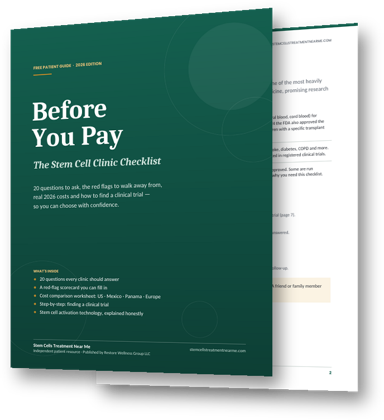
Before You Pay: The Stem Cell Clinic Checklist
- 20 questions every legitimate clinic should answer in writing
- A red-flag scorecard to spot unregulated marketing
- Realistic 2026 cost ranges: US, Mexico, Panama & Europe
- How to find a registered clinical trial
Keep reading
- What Is Stem Cell Therapy? A Plain-Language Guide for Patients
- How Much Does Stem Cell Therapy Cost in 2026?
- How to Find a Legitimate Stem Cell Clinic Near You
Medical Disclaimer: This article is for informational purposes only and does not constitute medical advice. Always consult a qualified medical professional before pursuing any treatment. See our full Medical Disclaimer.
Exploring your stem cell options? Use our free Clinic Finder to learn how to find and vet a legitimate stem cell clinic near you.