Imagine if the tiny teeth your child lost years ago — those little milestones tucked away in keepsake boxes — could one day hold the key to treating a serious neurological condition. That idea is no longer just a dream. Researchers are now exploring how stem cells harvested from baby teeth may offer a meaningful new path forward for children and young adults living with cerebral palsy. For families who have spent years searching for answers, this emerging science brings genuine hope worth understanding.
What Is Cerebral Palsy, and Why Is Treatment So Challenging?
Cerebral palsy (CP) is a group of conditions that affect movement, muscle tone, and coordination. It is caused by damage to the developing brain — most often before or shortly after birth. In the United States alone, approximately 1 in 345 children is diagnosed with cerebral palsy, making it the most common motor disability in childhood.
Current treatments focus largely on managing symptoms. Physical therapy, occupational therapy, medications to control muscle spasticity, and in some cases surgery can improve quality of life — but none of these approaches repair the underlying brain injury. That gap between managing symptoms and actually healing the root cause is exactly where stem cell research is stepping in.
Where Do Baby Tooth Stem Cells Come From?
When a child loses a baby tooth — also called a deciduous tooth — the soft tissue inside, known as the dental pulp, contains a rich supply of stem cells. These are called dental pulp stem cells (DPSCs). Unlike stem cells harvested from bone marrow, which can require a painful extraction procedure, baby teeth are naturally shed and often simply discarded.
Scientists have discovered that DPSCs are remarkably versatile. They belong to a category called mesenchymal stem cells (MSCs) — a type of cell that has the ability to develop into several different cell types, including nerve-supporting cells. This makes them particularly interesting for brain-related conditions like cerebral palsy.
Why Dental Pulp Stem Cells Are Especially Promising
According to reporting by RegMedNet, dental pulp stem cells have shown several qualities that make them well-suited for neurological therapies:
- They are easy to collect. Shed baby teeth provide a non-invasive and ethically straightforward source of stem cells.
- They have strong anti-inflammatory properties. Inflammation plays a major role in ongoing brain damage after the initial injury in CP. Stem cells that can calm this inflammation may help protect remaining healthy tissue.
- They can support nerve growth. Early research suggests DPSCs may encourage the survival and regeneration of neurons — the brain’s communication cells.
- They are immunologically compatible. When used from the child’s own teeth, these cells carry the child’s own genetic material, reducing the risk of rejection.
What the Research Is Showing So Far
While this field is still in its early stages, the initial findings are encouraging. Preclinical studies — meaning experiments conducted in laboratory settings and animal models — have shown that dental pulp stem cells can reduce brain injury markers, decrease inflammation, and improve motor function in subjects with CP-like conditions. These results have been promising enough to support moving toward human clinical trials.
Clinical Trials: The Next Frontier
As reported by RegMedNet, researchers are now working to translate these laboratory findings into carefully designed human trials. Clinical trials follow a strict process to ensure safety and effectiveness before any treatment can be widely offered to patients. Phase I trials focus primarily on safety — making sure a new treatment does not cause harm. Phase II trials begin evaluating whether the treatment is actually working.
For families and patients, this means that while dental pulp stem cell therapy for cerebral palsy is not yet a standard, widely available treatment, it is moving through the rigorous scientific process that all legitimate medical advances must follow.
What This Could Mean for Real Families Today
If you are a parent of a child with cerebral palsy, or if you are an adult living with the condition, you are right to pay attention to this research — while also remaining thoughtfully cautious. Here is what this science realistically means right now:
Banking Baby Teeth May Become Valuable
Some families are now choosing to preserve their children’s baby teeth through specialized dental stem cell banking services. Much like cord blood banking after birth, this involves storing the dental pulp in a facility that keeps the cells viable for potential future use. If therapies using a child’s own DPSCs become available, having those cells already banked could be a meaningful advantage.
Not All “Stem Cell Clinics” Are Equal
It is important to note that not every clinic offering stem cell therapy operates at the same level of scientific rigor. Some clinics offer unproven treatments with little evidence to back them up. As with any medical decision, patients and families should ask hard questions, look for transparency about what stage any treatment is in, and ideally seek care connected to legitimate research programs or regulated clinical trials.
Stay Informed and Stay Connected to Your Care Team
The most important step any patient can take right now is to talk openly with their neurologist, pediatrician, or specialist about emerging therapies. As clinical trial results become available over the coming years, the picture will become clearer. Staying informed — through trusted sources and open conversations with your medical team — puts you in the best position to make decisions that are right for your family.
A Reason for Measured Hope
The idea that something as ordinary as a lost baby tooth could one day contribute to healing a brain injury is a powerful reminder of how far regenerative medicine has come. Dental pulp stem cells represent a genuinely exciting frontier in cerebral palsy research. The science is young, but it is moving forward with purpose — and for the millions of families touched by this condition, that progress is deeply meaningful.
Source: Stem cells from baby teeth: a promising treatment for cerebral palsy — RegMedNet
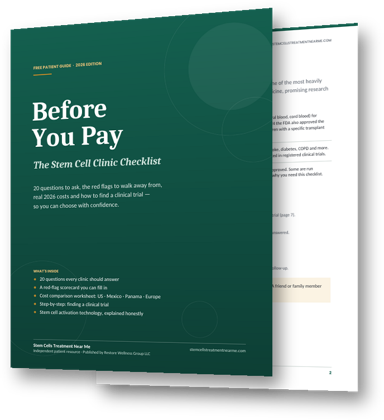
Before You Pay: The Stem Cell Clinic Checklist
- 20 questions every legitimate clinic should answer in writing
- A red-flag scorecard to spot unregulated marketing
- Realistic 2026 cost ranges: US, Mexico, Panama & Europe
- How to find a registered clinical trial
Keep reading
- What Is Stem Cell Therapy? A Plain-Language Guide for Patients
- How Much Does Stem Cell Therapy Cost in 2026?
- How to Find a Legitimate Stem Cell Clinic Near You
Medical Disclaimer: This article is for informational purposes only and does not constitute medical advice. Always consult a qualified medical professional before pursuing any treatment. See our full Medical Disclaimer.
Exploring your stem cell options? Use our free Clinic Finder to learn how to find and vet a legitimate stem cell clinic near you.