Imagine being diagnosed with leukemia and facing the frightening reality that no perfect donor match exists for you. That is exactly what one woman experienced — and instead of staying silent, she took her story to social media, reaching over 1.5 million people with a message of hope about a treatment many patients have never heard of: partial-match stem cell transplantation. Her journey, shared publicly through UChicago Medicine, is opening doors for patients everywhere who thought they had run out of options.
A Diagnosis That Changed Everything
Leukemia is a cancer of the blood and bone marrow. It disrupts the body’s ability to produce healthy blood cells, and for many patients, a stem cell transplant — sometimes called a bone marrow transplant — is one of the most powerful treatment tools available. The idea is straightforward: replace the damaged or cancerous blood-forming cells with healthy ones from a donor.
But here is the challenge most people never think about until they are sitting in a doctor’s office: finding a perfectly matched donor is incredibly difficult. For patients from diverse ethnic backgrounds especially, the odds of finding a full match through national registries can be discouraging. This is where the story of this remarkable woman, treated at UChicago Medicine, becomes so important for patients to hear.
What Is a Partial-Match Stem Cell Transplant?
A partial-match transplant — known medically as a haploidentical transplant, or “haplo” transplant — uses stem cells from a donor who only partially matches the patient’s tissue type. In a traditional transplant, doctors look for a donor whose human leukocyte antigen (HLA) markers, proteins on the surface of cells, closely mirror the patient’s own. With a haploidentical transplant, doctors work with a donor who matches roughly 50% of those markers.
Who Can Be a Partial Match?
Here is the part that many patients find genuinely encouraging: a partial match is often right in the patient’s own family. Parents, children, and siblings are naturally about a 50% HLA match with each other. This means that for patients who cannot find a full donor match — whether through a registry or among family members — a parent, child, or sibling may still be eligible to donate. In many cases, this dramatically widens the pool of potential donors.
How Has This Become Possible?
Advances in transplant medicine, particularly in the drugs used to prevent the immune system from rejecting the new cells (a process called graft-versus-host disease, or GVHD), have made haploidentical transplants far safer and more effective than they were just a decade ago. The UChicago Medicine team caring for this patient used these modern techniques, and the results have been life-changing. According to UChicago Medicine, this approach is now being used more widely as outcomes continue to improve.
Why She Chose to Share Her Story Publicly
For this patient, going through treatment was not something she wanted to do in isolation. She turned to social media — reaching 1.5 million followers — to document her leukemia battle and her experience with the partial-match transplant. Her reasons were deeply personal and powerfully practical: she wanted others facing similar diagnoses to know that options exist, even when things look bleak.
Her transparency has done more than inspire. It has educated. Many of her followers had never heard of haploidentical transplants before following her journey. Some reached out to say they were reconsidering whether to give up on finding a donor. Others said her story prompted them to talk to their own doctors about transplant options they had previously dismissed.
What This Means for Patients Today
If you or someone you love has been told that no suitable donor match exists, this story carries a very clear message: the conversation is not necessarily over. Medical science has evolved, and partial-match transplants are a legitimate, increasingly common pathway that deserves to be part of that conversation.
Questions Worth Asking Your Doctor
If you are exploring stem cell or bone marrow transplant options, consider bringing these questions to your next appointment:
- Am I a candidate for a haploidentical (partial-match) stem cell transplant?
- Which family members could potentially serve as partial-match donors?
- What is the current evidence for outcomes with haploidentical transplants for my specific diagnosis?
- Is my care team experienced in managing graft-versus-host disease after a partial-match procedure?
- Are there clinical trials I should know about?
The Importance of Seeking a Specialist
Not every oncology center has deep experience with haploidentical transplants. Seeking care at a facility with a dedicated transplant program — one that performs these procedures regularly — can make a meaningful difference in both safety and outcomes. It is always appropriate to ask for a second opinion or a referral to a specialized transplant center if you feel your current options are limited.
The Power of Patient Voices in Medicine
One of the quieter lessons in this woman’s story is the power that patients hold. By sharing her experience openly, she has helped demystify a complex procedure and given real hope to people who may have felt invisible in the medical system. For patients aged 40 and older — who statistically represent the majority of blood cancer diagnoses — hearing from someone who has walked this road can be just as important as reading a clinical study.
If you are navigating a diagnosis right now, know that you are not alone. Stories like hers remind us that medicine is advancing quickly, that donor matching is no longer an all-or-nothing proposition, and that asking questions and seeking specialized care can genuinely change outcomes.
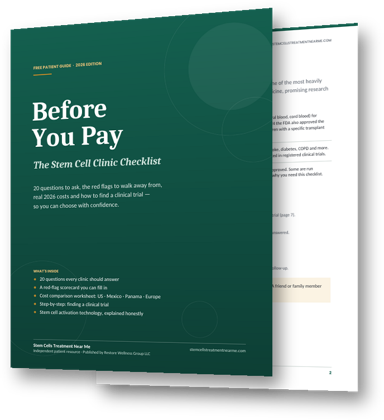
Before You Pay: The Stem Cell Clinic Checklist
- 20 questions every legitimate clinic should answer in writing
- A red-flag scorecard to spot unregulated marketing
- Realistic 2026 cost ranges: US, Mexico, Panama & Europe
- How to find a registered clinical trial
Keep reading
- What Is Stem Cell Therapy? A Plain-Language Guide for Patients
- How Much Does Stem Cell Therapy Cost in 2026?
- How to Find a Legitimate Stem Cell Clinic Near You
- More conditions being treated with stem cells
Medical Disclaimer: This article is for informational purposes only and does not constitute medical advice. Always consult a qualified medical professional before pursuing any treatment. See our full Medical Disclaimer.
Exploring your stem cell options? Use our free Clinic Finder to learn how to find and vet a legitimate stem cell clinic near you.