If you or someone you love is exploring stem cell therapy, you may have seen recent news stories that raise serious questions about safety, regulation, and the risks of pursuing unproven treatments. A report from The Guardian has brought renewed attention to a troubling practice: autistic children being given unapproved stem cell injections — treatments that have not been reviewed or authorized by the U.S. Food and Drug Administration (FDA). As a patient weighing your own treatment options, understanding what is happening — and why it matters — could be one of the most important steps you take before making any decision.
What the News Is Actually Saying
According to reporting by The Guardian, autistic children in the United States are receiving stem cell injections that have not gone through the FDA’s formal approval process. These are not treatments offered through legitimate clinical trials or licensed medical facilities following standard protocols. Instead, they are being administered outside the system that exists specifically to verify whether a treatment is safe and effective.
The report also notes that Robert F. Kennedy Jr. — a prominent public figure who has voiced skepticism about mainstream medicine — has expressed support for these types of unapproved treatments. His endorsement has amplified attention around them, potentially encouraging families to seek out similar options without fully understanding the risks involved.
Why FDA Approval Matters for Your Safety
You might be wondering: if a treatment seems to be helping someone, why does it matter whether a government agency has approved it? That is a completely fair question — and the answer goes to the heart of patient protection.
The Approval Process Exists to Protect You
The FDA’s review process for any medical treatment — including stem cell therapies — involves multiple stages of clinical testing. These stages are designed to answer two essential questions: Does it work? And Is it safe? Without this process, there is no reliable way for a patient, or even a well-meaning doctor, to know whether a treatment is genuinely beneficial or potentially harmful.
Stem cells are powerful biological tools. They have the ability to develop into many different types of cells in the body, which is exactly why researchers believe they hold so much promise for treating a wide range of conditions. But that same power means they must be handled with great care. Administering them incorrectly — or using cell sources that have not been properly screened and processed — can lead to serious complications, including infections, immune reactions, and in rare cases, the formation of abnormal growths.
Unapproved Does Not Mean Natural or Harmless
One common misconception is that because stem cells come from biological sources, they are inherently safe. This is not accurate. The origin of the cells, how they are stored, how they are prepared, and how they are delivered into the body all play a critical role in determining both safety and effectiveness. Unapproved treatments often lack transparency about any of these factors.
What This Means for Patients Considering Stem Cell Therapy Today
If you are between 40 and 75 years old and exploring stem cell therapy for conditions like joint pain, arthritis, neurological issues, or other age-related concerns, stories like this one can feel confusing or even discouraging. The good news is that legitimate, carefully regulated stem cell treatments do exist — and there are important steps you can take to protect yourself.
Know the Difference Between Approved and Unapproved Treatments
In the United States, there are FDA-approved stem cell therapies — primarily for certain blood disorders and cancers, using bone marrow or cord blood transplants. Beyond those, there are also FDA-authorized clinical trials where patients can receive experimental stem cell treatments under careful medical supervision. What you want to avoid are clinics or providers offering stem cell injections outside of these frameworks, especially those making bold claims without published research to back them up.
Red Flags to Watch For
When evaluating any stem cell clinic or provider, be cautious if you notice any of the following:
- Promises of a “cure” for conditions that have no established stem cell treatment
- No mention of clinical trial registration or FDA oversight
- Pressure to pay large sums upfront before you have had time to research
- Celebrity or political endorsements used in place of scientific evidence
- Vague explanations of where the stem cells come from or how they are processed
Questions to Ask Before You Commit
A trustworthy provider will welcome your questions. Before agreeing to any stem cell treatment, consider asking: Is this treatment part of an FDA-approved protocol or registered clinical trial? What are the known risks and side effects? What evidence supports this treatment for my specific condition? Who will be administering the therapy, and what are their credentials?
The Bigger Picture: Protecting Vulnerable Patients
The children described in The Guardian‘s report represent some of the most vulnerable patients imaginable — young people with autism whose families are searching desperately for help. That desperation is completely understandable. But it is precisely this vulnerability that unscrupulous providers can exploit, whether intentionally or through genuine but misguided belief in treatments that have not been proven to work.
For adult patients, the same emotional drivers are often present. Pain, fatigue, a loss of independence, and the hope that something — anything — might restore quality of life can make it tempting to pursue options that promise quick results. Protecting yourself means pausing to ask the hard questions, even when hope feels urgent.
Moving Forward with Confidence
Stem cell research is advancing rapidly, and there are real reasons to be optimistic about the future of regenerative medicine. Legitimate researchers and clinicians are working every day to develop treatments that are both effective and safe. The best way to benefit from that progress is to connect with providers who are operating within that framework — not outside it.
Take your time. Ask questions. Consult with your primary care physician or a specialist you trust. And use verified resources to find clinics that meet established standards of care.
More recent developments
We have combined our coverage of related news into this single guide. Here are further updates on this topic:
Stem Cell Therapy: What Patients Need to Know
A recent investigative report from The Guardian is raising serious questions about a fast-growing corner of the stem cell industry that experts say is putting vulnerable patients — including children — at risk. Here is what you need to know, and how to protect yourself or your loved one. According to The Guardian’s investigation, America is experiencing a booming, largely unregulated market for stem cell infusions being marketed to families of autistic children.
Source: ‘Autistic kids are being experimented on’: inside America’s booming market for unproven stem cell infusions. The Guardian. Available at: The Guardian via Google News.
Stem Cell Therapy Safety What Patients Need to Know
A recent article published in PNAS (Proceedings of the National Academy of Sciences) is drawing renewed attention to why FDA oversight of stem cell therapies matters deeply — not just for public health in the abstract, but for you as a patient making one of the most important healthcare decisions of your life. The PNAS article, titled “FDA must regulate stem cell therapies to mitigate risks to patients and the public,” makes a direct case: without consistent federal oversight, patients are being exposed to treatments that have not been properly vetted for safety or effectiveness. This isn’t a new concern, but it is an increasingly urgent one as the number of clinics offering stem cell treatments in the United States continues to grow rapidl
Source: “FDA must regulate stem cell therapies to mitigate risks to patients and the public,” PNAS
Stem Cell Therapy Results What You Need to Know
Researchers have long been fascinated by their potential to repair and regenerate damaged tissue. In legitimate medical settings, certain types of stem cell therapies have shown real promise for specific conditions, including some blood diseases and immune disorders. Anti-aging stem cell injections, however, are a different category entirely.
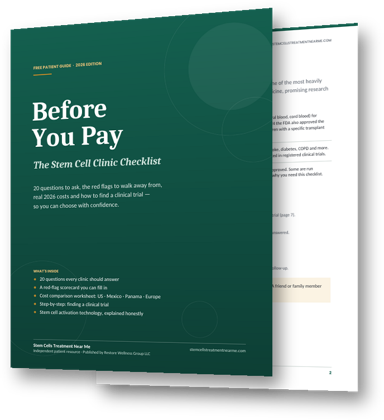
Before You Pay: The Stem Cell Clinic Checklist
- 20 questions every legitimate clinic should answer in writing
- A red-flag scorecard to spot unregulated marketing
- Realistic 2026 cost ranges: US, Mexico, Panama & Europe
- How to find a registered clinical trial
Keep reading
- What Is Stem Cell Therapy? A Plain-Language Guide for Patients
- How Much Does Stem Cell Therapy Cost in 2026?
- How to Find a Legitimate Stem Cell Clinic Near You
Medical Disclaimer: This article is for informational purposes only and does not constitute medical advice. Always consult a qualified medical professional before pursuing any treatment. See our full Medical Disclaimer.
Exploring your stem cell options? Use our free Clinic Finder to learn how to find and vet a legitimate stem cell clinic near you.